Mandala of Mourning
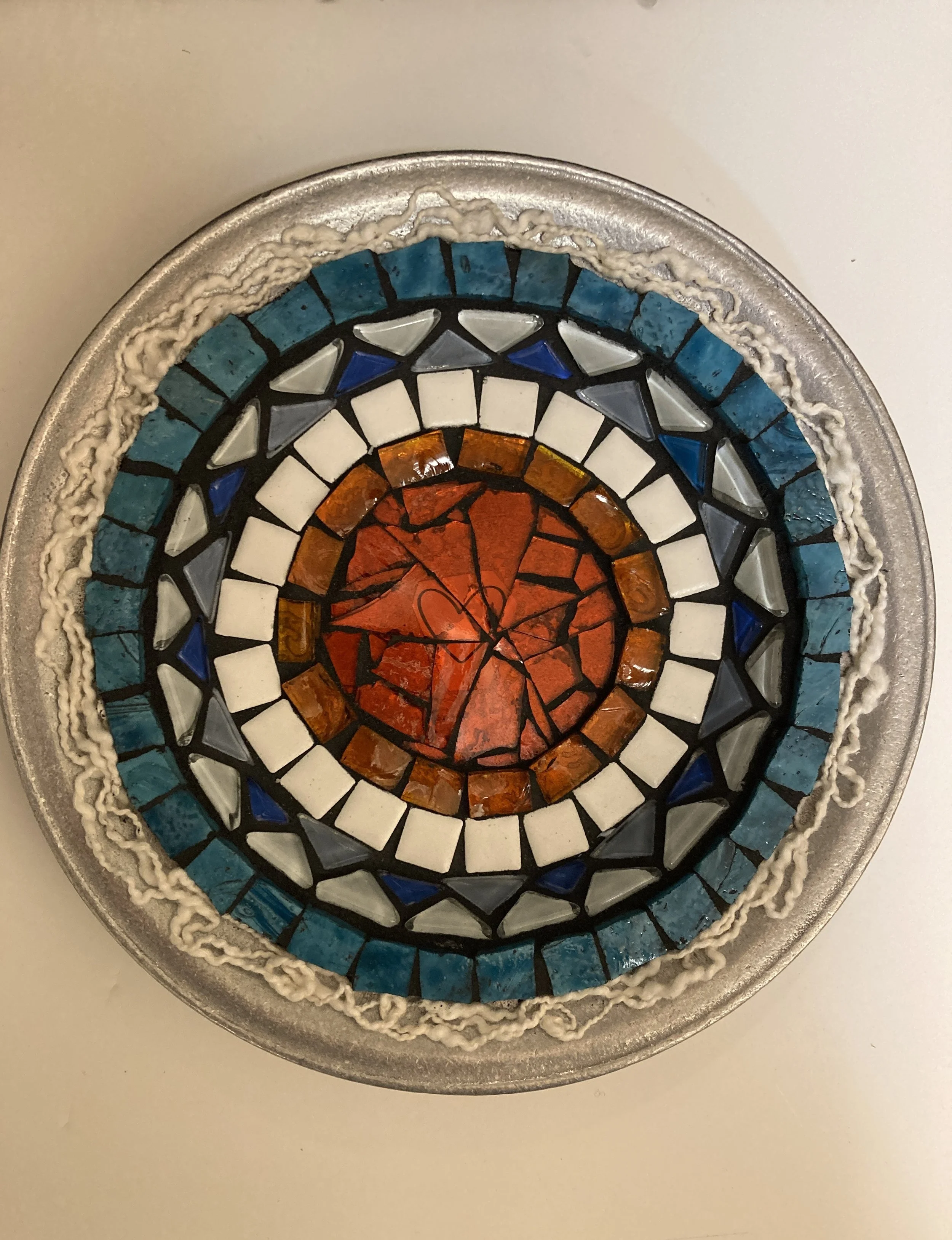
Multi-media - pewter, smalti, glass, tiles, paper, yarn
Following the news that Shiri, Kfir, and Ariel Bibas had been brutally murdered by the Mujahideen Brigades, in connection with Hamas, my heart was broken. The need to mourn lead me to create this “mandala of mourning” for the Bibas family and, also in memory of all of the children murdered or orphaned by Hamas, on or after October 7, 2023.
The Layers:
In the center is a broken heart. The orange broken heart became a symbol of grieving and community support from throughout the world, after the release of the bodies of Shiri, Kfir, and Ariel Bibas. The heart in the center of this piece comes from a girls coloring book, “I am an Adventurer, Artist & Athlete”, that belonged to my grandchild (age 8). They had colored the heart with an orange felt tip marker.
The broken orange glass further highlights the unforgettable red/orange har of the Bibas children that was also seen across the world. The video of their kidnapping, in the arms of their terror stricken mother, haunts me. The broken orange glass is also symbolic of the fire that Hamas terrorists used to destroy homes on the Bibas’s kibbutz, Nir Oz, The smalti glass rectangular bricks are hand cut and often remain jagged and sharp, like a bad dream.
The whites and the blues are reminiscent of the Israeli flag, and also of the Tallit(s) or prayer shawl, worn in service and reverence for God, during prayer, at B’nei Mitzvot, weddings, burials, and other Jewish life cycle events.
The darker blue triangles number 10. Ten is the number of Jewish people (and in some traditions only men) that constitute a “minyon”. Some sacred prayers can only be recited with the gathering of a minyon. This includes the Kaddish prayer for the dead. I surround the center with a minyon to echo the recitation of the Kaddish. The light blue triangles also number 10. These represent the 10 commandments that guide Jewish daily life and service to God, Ruler of the Universe. These commandments guide us to honor and respect God, and to cherish the value of every human life.
The blue smalti glass included in the last two layers reminds me of the indigo dye of the tallit, and here it is surrounded by a yarn (from my mother’s {Z”L} crochet yarn) reminiscent of the fringes of the tallit.
This outermost layer, the fringes of the tallit, surround and embrace all of the children’s innocence, fear and tears. May their (HY”D) memory be a blessing and may we never forget!
Tessera to IntessauraeMKE
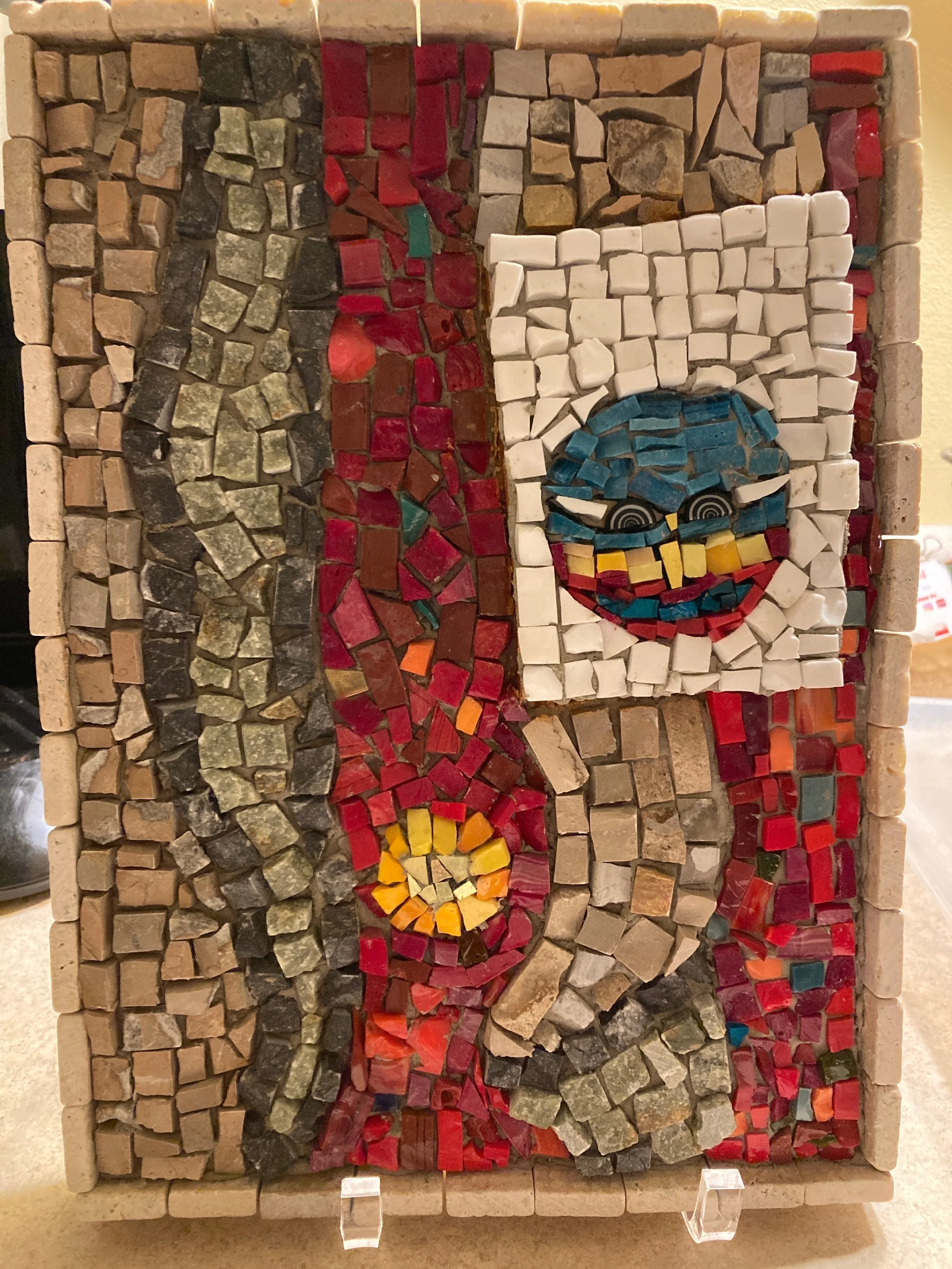
Mixed media - Stone, marble, glass, paint, millefiore, on wood
Tessera are the pieces that are placed into a mosaic, including, tiles, glass, stone, marble, etc. I had the wonderful opportunity to participate in a workshop taught by Tiziana Mondini, at Tessere Scuola di Mosaico, in Narni, Italy. (FYI, Narni is what inspired The Chronicles Of Narnia.) The experience was beyond my expectations. The generosity of Tiziana and her assistant in sharing their expertise, materials, guidance, and other resources, was extraordinary. My interest was to learn the Roman technique of creating mosaics, laying mortar and then adhering the tesserae. However, I did not want to create a traditional Roman-looking mosaic with mostly muted colors and often used patterns. Once I explained my interest, my teachers provided a variety of marble, stone and colorful glass, trained me to use some new tools, and set me to work. I also expressed interest in emulating a particular painter of the post-war modern movement, Friedensreich Hundertwasser. His belief in the power of nature and individual creativity and his color palette attracted me to adapt his work to mosaic interpretation. Hundertwasser often used facial features like eyes and mouths in his landscapes. Though my translation may not necessarily evoke the viewer to make the connection, this was my inspiration in creating this piece, using the tools and materials at hand.
It was after I returned back from Italy that I was motivated to set up my own workshop/studio. I also applied for and received a small business grant for starting a woman-owned small business. I found my perfect space right near my home. Having a special place to create has lead me to a joyous place in my artist journey, both figuratively and literally. In honor of my experience at Tessere Scuolo di Mosaico, I named my studio Intessaurae MKE.
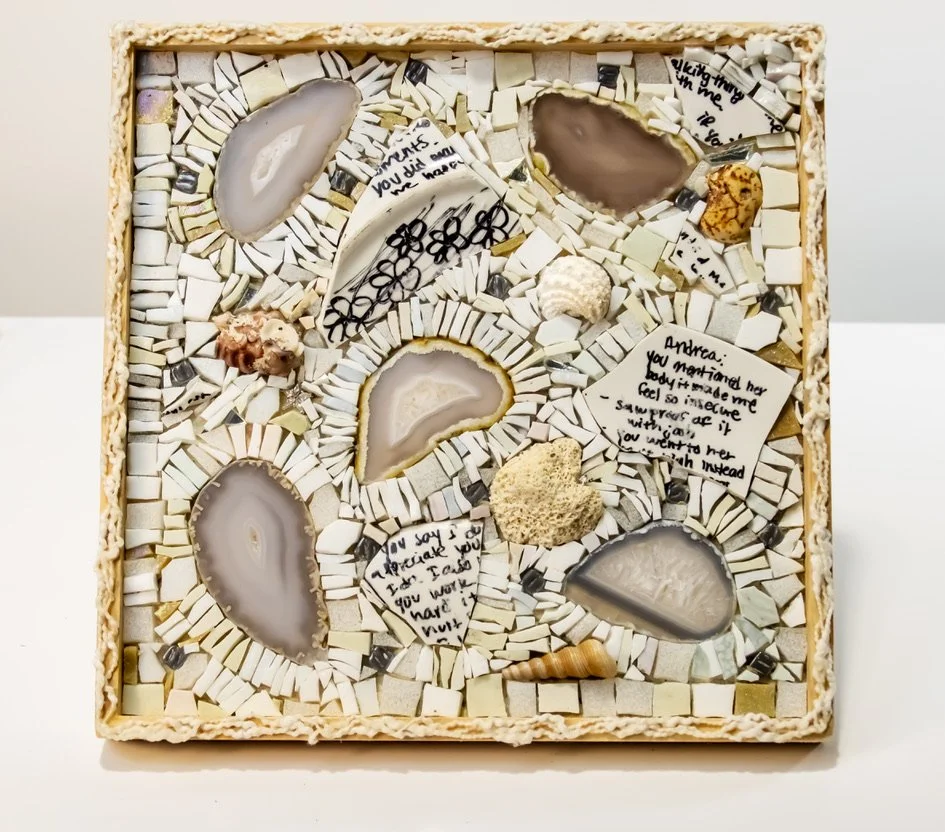
Heartbreak
-Not Only Do The Waves Crash-
————
Mixed media - Smalti, broken plate, geode slices,
shells, wood, mirror, jewelry, yarn
—————————
While walking along the North Docks at the McKinley Marina, in Milwaukee, I looked down on the sidewalk to find the broken pieces of a white plate. On the plate there was writing. The writing was done by hand with a black medium, felt tip pen. When I further investigated, it became clear that this plate represented a catharsis, of sorts, for a scorned lover. Someone had written to their lover to express their hurt and heartbreak, on the white plate, and then tossed it, violently, crashing to the ground. I confess that this action, in such a circumstance, could also be quite satisfying to me.
Within this mixed media mosaic, you will find some of the broken pieces of the plate and some sparkles which I added, reminiscent of a discarded diamond ring. Note the smalti glass, which has been hand poured and then cut in jagged and sharp shapes. I also added shells and geode slices that hint at where the pieces were found, near the beach. The surrounding crochet yarn represents twisted sailboat ropes which one might associate with the nearby marina. The substrate (or backing) is unfinished wood, which reminds me of driftwood washed up on the beach.
Even without this story, I believe you would see my experiment, creating a white on white mosaic that lacks a smooth “andamento" or flow, opting instead for a choppy movement and the feeling of turmoil that comes with heartbreak.
An Interpretive Mosaic
An interpretive mosaic - I was given a small portion of a painting and created a mosaic interpretation of the section. It has been added to a larger piece, in which all of the small sections (created by many other League of Milwaukee Artists in different mediums) will be attached as in the original . See the full picture, below, with almost all of the artists puzzle pieces put together!
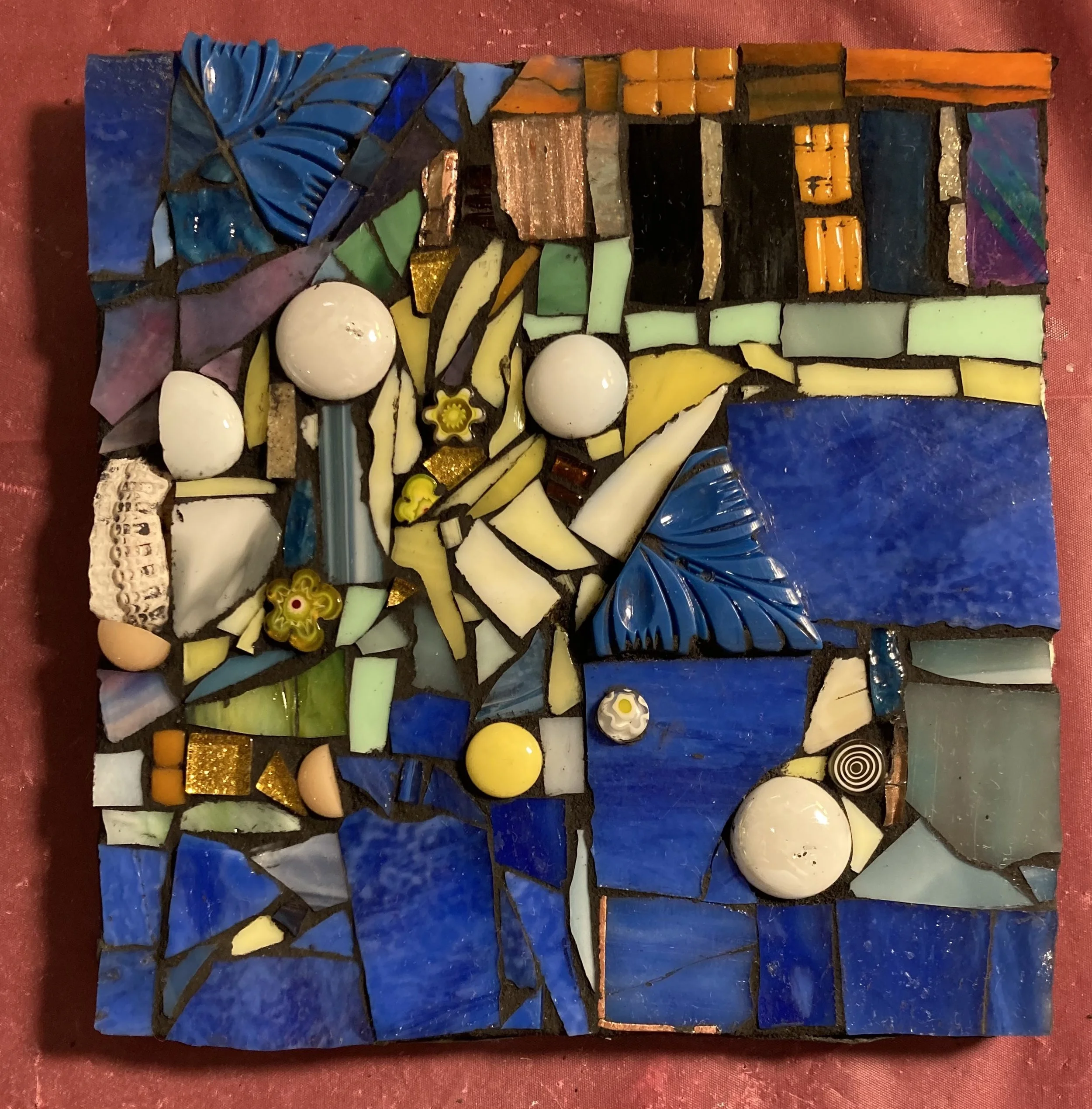

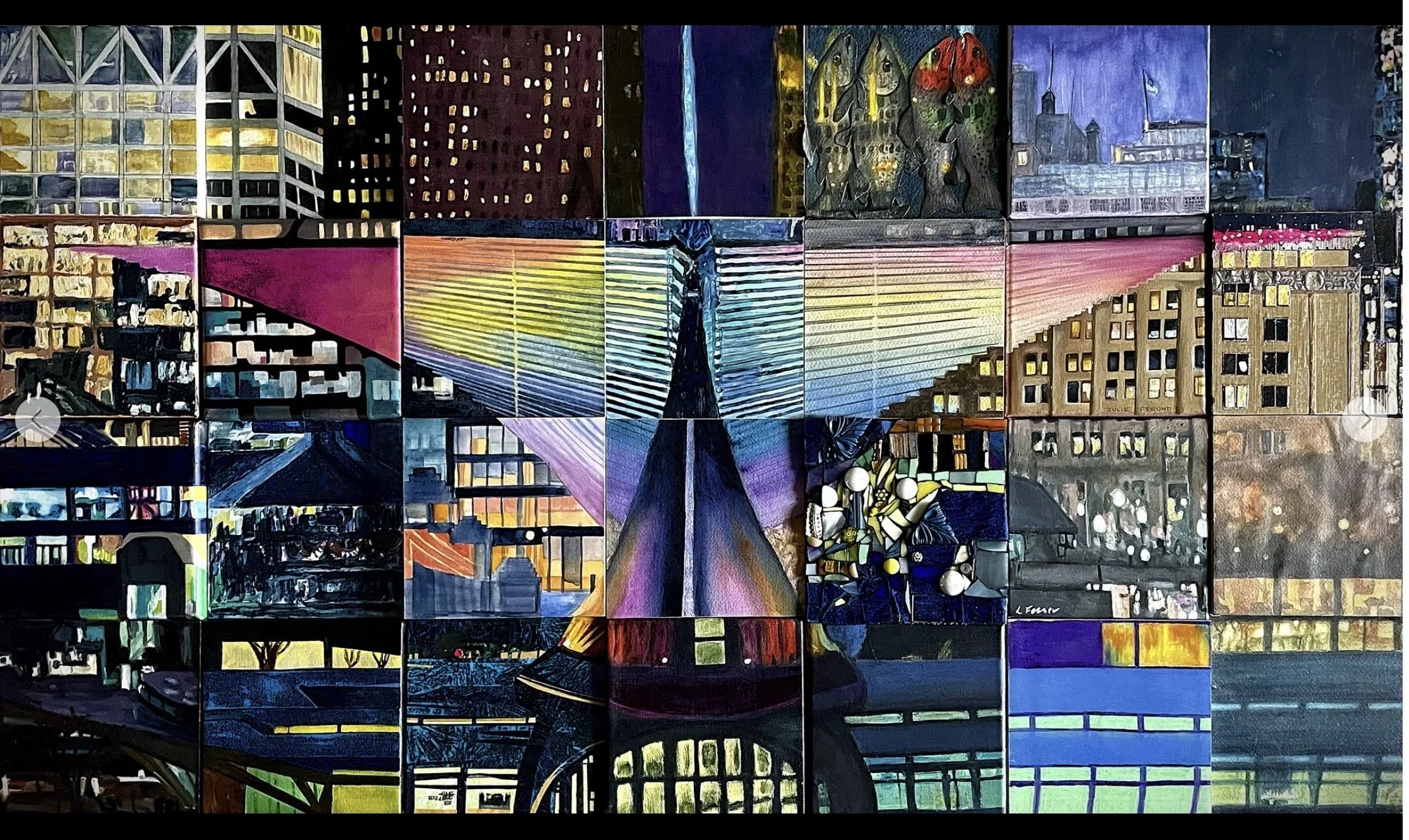
Can you find the mosaic in this assembled picture of the Milwaukee Art Museum??
(Courtesy of the League of Milwaukee Artists)
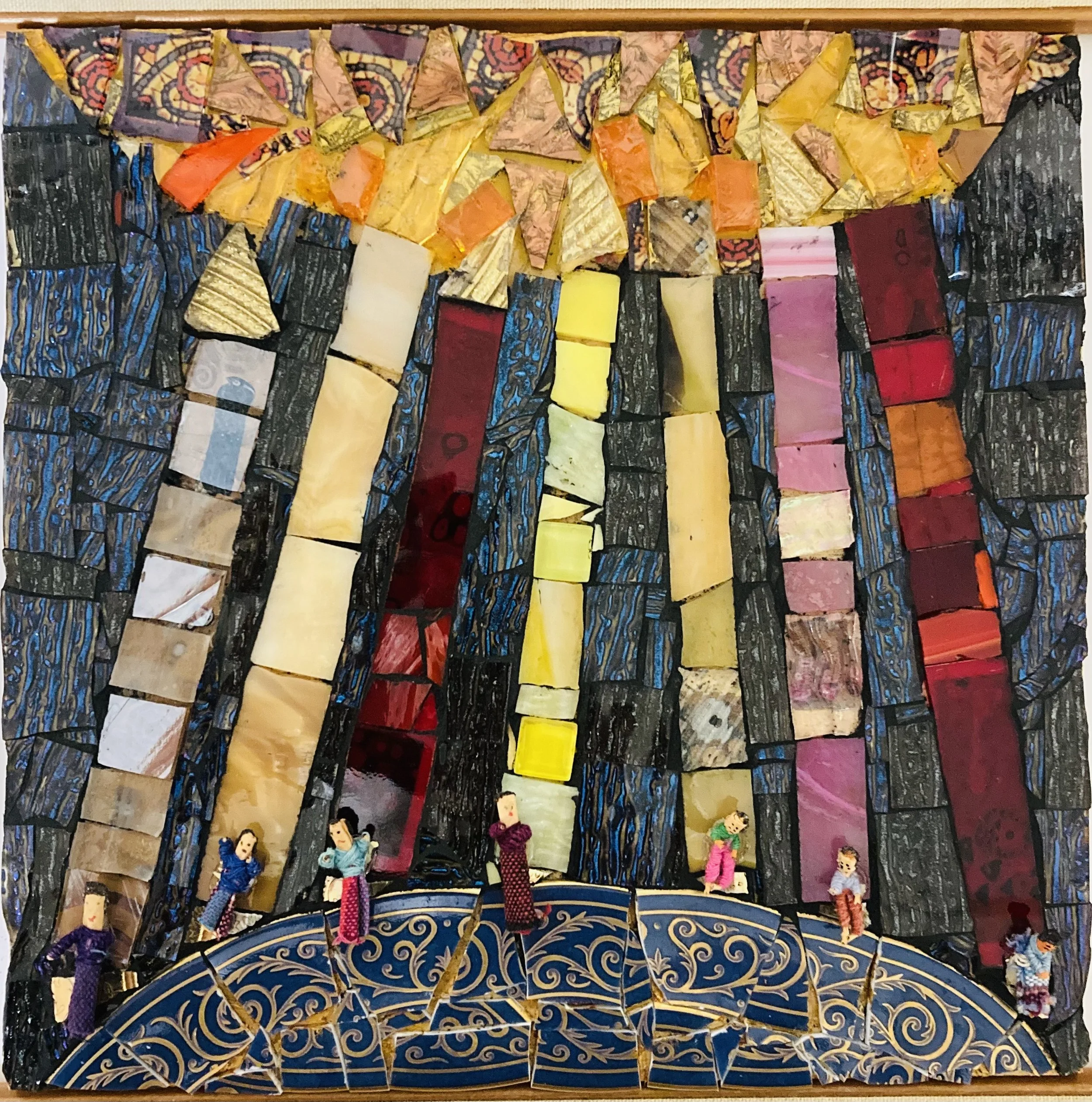
Seven Middot
The underlying themes of the menorah include light, divine attributes, and the significance of creation. In this mosaic, emphasis is on the seven branches of the Menorah from the Holy Temple representing the seven types of souls (Kabbalah). The unique characteristics of these different souls enable us to love God and love one another. We each possess these attributes (Middot) in different measure.
Kindness
Severity
Harmony
Perseverance
Humility
Foundation
Royalty
While every soul possesses all seven of these middot, one is most dominant, shaping our individual and unique way of serving God and of loving others.We all may ask which of these describes us:
Chesed (Kindness) — characterized by a calm and flowing love. This soul overflowis with love for others.
Gevurah (Severity) – serves God with awe and a flaming passion. Highly disciplined, with high expectations of oneself and others.
Tiferet (Harmony) – a perfect synthesis of Kindness and Severity, said to be accomplished through the study of Torah. Tiferet is the source of the soul's capacity for compassion.
Netzach (Perseverance) – constantly battling and struggling, but ultimately triumphant.
Hod (Humility) – exemplifies letting go of the need for control and accepting that one's strengths come from a greater, universal source.
Yesod (Foundation) – unique talent in establishing giving relationships, intellectually or otherwise.
Malchut – (Royalty) - serves God in a majestic manner, integrating love, awe, compassion, endurance, humility, and foundation into a complete expression.
In the first temples’ menorah, all seven branches were hewn from a single block of pure gold. We may have different dispositions and different methods of serving God and others, but we are essentially one. We are all pointed to the center, as are the flames of this menorah, with one purpose and one mission, to be a guiding light, bringing forth the Divine.